

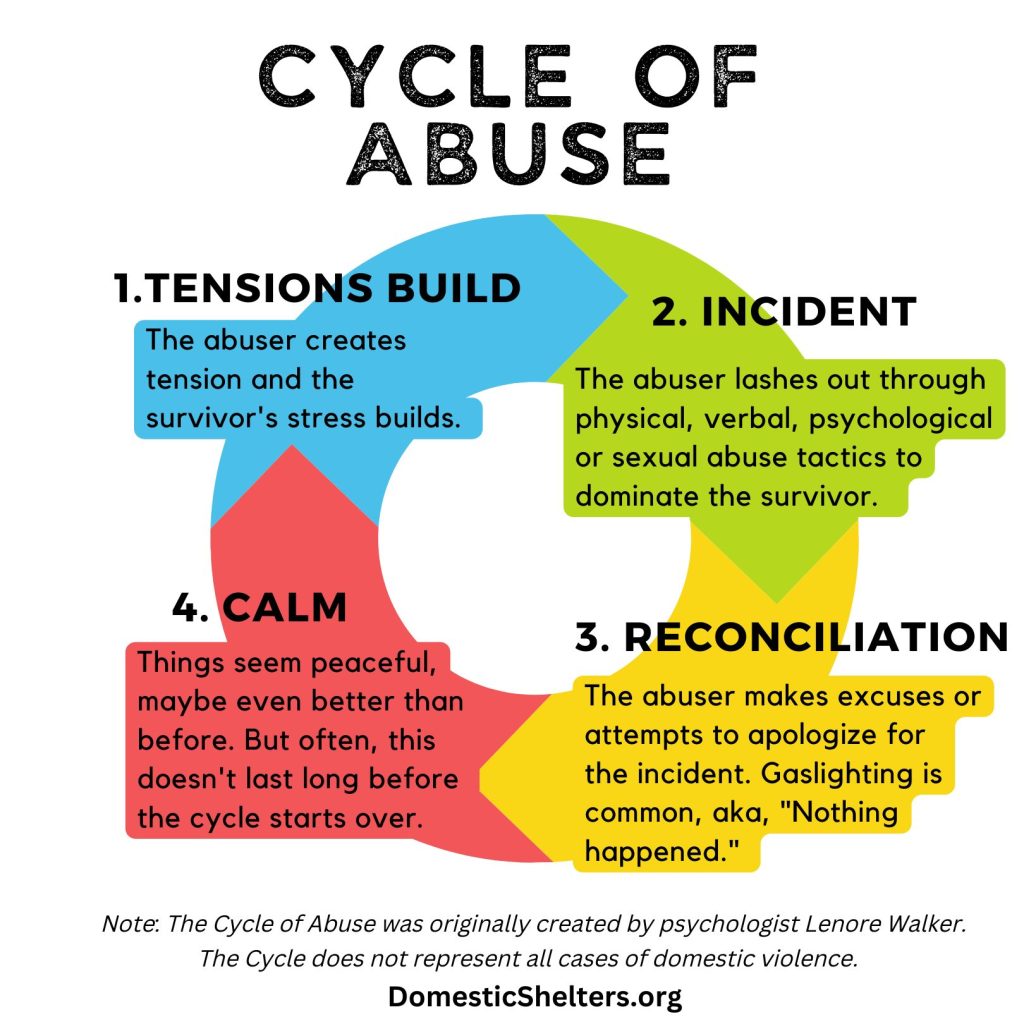
The cycle of violence is a repeating pattern often seen in abusive relationships. It involves three different stages that continuously repeat until the victim is able to leave the relationship. What often makes the situation even worse is that as the cycle continues the violence often escalates and worsens.
Tension Building
The rise of tension in the relationship manifest itself into passive aggression, emotional distance between the partners and establishes a tense and agitated state in the relationship. As a result of the tension, the non-violent partner develops a heightened sense of fear and anxiety. As the tension begins to increase, so does the verbal, emotional and financial abuse. This causes the non-violent partner to feel as though the situation will explode if they do anything wrong. The behavior intensifies and reaches a point where the release of this tension is inevitable.
Significant Other:
The partner becomes increasingly agitated and aggressive.
Some behaviors include:
- Gaslighting
- Criticizing
- Displaying moody behavior
- Drinking/drugs
- Nitpicking
- Putting-down
- Threatening
- Withdrawing affection
- Yelling
Victim:
The victim senses their partner’s agitation and has the feeling of walking on eggshells and they will do anything to avoid the impending explosion.
Some behaviors include:
- Agreeable/rarely disagrees
- Attempting to calm/soothe
- Intense focus on keeping children quiet
- Excessive nurturing
- Staying away from family and friends
- Trying to please their partner
- Trying to reason with them
Acute Explosion
Once the tension boils over, the acute explosion that follows is the violent and abusive action. These actions come in many forms such as physical, emotional, sexual and financial abuse. This incident serves as a means of intimidation to establish the partner’s power and control. The gratification that follows the violent outburst is enough to release the tension felt between both parties. This behavior may become habitual.
Significant Other:
The partner initiates aggressive, verbal or physical abuse, in attempt to control and oppress the victim.
Some behaviors include:
- Destroying property
- Hitting
- Humiliating
- Imprisoning
- Sexual assault
- Strangulation
- Using weapons
- Verbally abusing
Victim:
The victim may feel the need to protect themselves, escape, or call for help.
Some behaviors include:
- Leaving
- Police called by victim or witness
- Protecting self
- Trying to calm their violent partner
- Trying to reason
Honeymoon
Both partners may be in denial about the severity of the abuse and violence. Intimacy can increase during this phase and may feel happy and want the relationship to continue, so they may not acknowledge the possibility that the violence could happen again. The sense of calm after the explosion involves the period following the apology or expressed sense of remorse on the part of the partner who chooses violence; typically, a sentiment of forgiveness or disregard for the prior abuse is not only implicit, but expected within the ‘Calm’ phase – the danger reported within the ‘Stages of Violence’ study is primarily evident regarding the repetitive nature innate within this cycle Over time, this phase passes, and the cycle may begin again.
Significant Other:
The violent partner feels guilty for inflicting abusive behavior, primarily out of a concern of being found guilty of abuse, shamed by others, or left by the victim, rather than feelings of sympathy for the victim.
Some behaviors include:
- Begging for forgiveness
- Crying
- Declaring love
- Enlisting family support
- Initiating romance gestures
- Promising to get help
- Self-mutilation
- Wanting to get counseling
Victim:
The victim feels relieved, cared about, and questions their responsibility for the abuse. They are happy to be in a place of peace and the victim believes there is hope for the future of the relationship.
Some behaviors include:
- Agreeing to stay
- Attempting to stop legal proceeding
- Feeling happy and hopeful of change
- Returning to taking back to the violent relationship
- Setting up counseling
The cycle of violence could occur hundreds of times in a relationship, and the severity and recurrence all depends on those involved. The stages themselves can even vary in length depending on the relationship. The cycle describes a pattern and a possible explanation for how and why victims stay in an abusive relationship. Often in the honeymoon stage, the abuser shows a side of themselves that the victim may truly love, pushing them further into the relationship and the continuous cycle. However, no matter how long the honeymoon phase lasts, or how severe the explosion becomes, the cycle needs to come to an end.
Written by: Frankie Best