


The person who chooses harm stands to gain many benefits from abusing victims such as power and control. They have learned that they can utilize various forms of abuse as a way of getting whatever they want. Witnessing family violence as a child is often the precipitating factor.
Children acquire information, skills, and behaviors through watching other people in their environment and then imitating or modeling what they do or say. The four factors that influence this type of modeling include:
- Attention- To learn, observers must pay attention to their environment. Attention levels can vary based on the characteristics of the model and environment where the individual is learning the behavior. Children are likely to pay attention to the behaviors of models that are similar to them in some way, often times the same sex parent. This is likely why boys who grew up in homes where domestic violence occurred are far more likely to choose to harm in future relationships.
- Retention- To continue the learning process, the child must also remember or retain the behavior. If the abuse is reoccurring, they are more likely to internalize the memories of it and perform the behavior themselves.
- Motor Reproduction- Once the child has paid attention to and retained the memory of the abusive behavior, they can begin to mimic this behavior on others. A child’s exposure to their father abusing their mother is the strongest risk factor for transmitting abusive behavior from one generation to the next.
- Motivation- Finally, all learning requires, to some extent, personal motivation. Motivation comes in the form of rewards and consequences. Personal motivation for people who choose to harm is the feeling of power and control
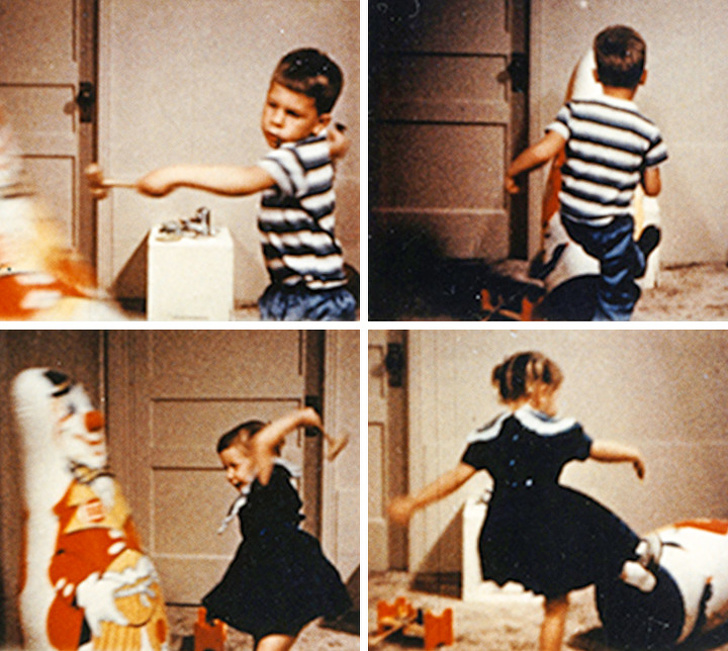
The Bobo Doll Experiment
This experiment showed that children could and would mimic abusive behaviors simply by observing others doing it.
In these experiments, children were shown a video where a model would act aggressively toward an inflatable doll by hitting, punching, kicking, and verbally assaulting the doll.
The end of the video had three different outcomes. Either the model was punished for their behavior, rewarded for it, or there were no consequences. After watching this behavior, children were given a bobo doll identical to the one in the video.
Children were more likely to mimic abusive behaviors when they observed the model receiving a reward, or when no consequences occurred.
Read more about this experiment here: https://www.simplypsychology.org/bobo-doll.html
Written by: Frankie Best