

When you think of a “couple,” what is the first image that comes to your mind? Are they dating or married? Do they live together? Do they have children? What is their home like?
The answers to these questions were probably different for everyone. Now, ask yourself: how old are they?
Many of you probably thought of an adult couple. But, as we know, teens can—and do—date. According to the Pew Research Center, around 35% of teens enter into at least one relationship before the age of 18 – some as young as 12 or 13.
While teen relationships may look different from adult relationships, that does not change how impactful and important these relationships can be for the teens in them. These relationships can be positive and promote personal growth – and they can also be abusive, just like adult relationships. Abuse in relationships among teens is called teen dating violence, or TDV. Unfortunately, the research shows that adults are not always aware of this reality. Rutgers found that as many as 81% of parents did not believe TDV was an issue, or had never heard of it. If you hadn’t heard of or thought about TDV up to this point, that’s okay. In honor of Teen Dating Violence Awareness Month this February, below we will discuss some quick facts about TDV.
The Problem at Hand
Contrary to popular belief, dating violence is just as common with teens as it is with adults. Around 1 in 3 teens will experience some kind of intimate partner violence before they turn 18 (Rutgers, n.d.). And, as with adult survivors of abuse, this can be any form of intimate partner violence. Verbal, emotional, and digital abuse tend to be the most common forms of abuse in teen relationships, but physical, sexual, and financial abuse can—and does—happen, too (Muñoz-Fernández et al., 2022).
Unfortunately, the vast majority of TDV goes unreported. Only 1 in 3 teens who have experienced TDV have ever reported it to an adult. This is cause for alarm, considering 50-80% of teens say they know a peer who has been abused, even if they have never been through it themselves (Rutgers, n.d.).
Teens from certain demographics may be more likely to experience abuse. In summary:
- Around half of LGBTQ+ teens experience some type of TDV, with teens identifying as transgender at particularly high risk (Rutgers, n.d.)
- Teens from areas with high income inequality are more likely to experience TDV than teens from areas with less income inequality (Adhia, et al., 2023)
- While not much research exists on the matter, some research shows that teens of color, especially Black teen girls, are more likely to experience abuse (Debnam et al., 2022)
Many of the teens who are more likely to experience abuse are from marginalized groups. They may be at elevated risk for abuse for many reasons, one of which being identity abuse. Identity abuse is defined as a type of intimate partner violence targeted at an aspect of who someone is that they cannot change, such as the color of their skin or their gender identity.
The Impact
Similar to abuse in adult relationships, TDV can be considered a public health crisis. Many studies suggest that experiencing teens experiencing abuse, especially without receiving adequate support, are more likely to abuse drugs, experience symptoms of anxiety and depression, and have poorer physical and mental health. Also, people who experience abuse as teens are more likely to be abused in their adult relationships (Campo-Tena et al., 2024; CDC, 2025; Sánchez-Zafra et al., 2024). Perhaps even more alarming, people who abuse their partner as a teenager are 13 times more likely to abuse an adult partner later in life.
Resources
While it may be easy to dismiss relationships between teens as less serious or immature, teens face mature problems in their relationships, too, just like adults. If you have, know, or are a teen experiencing abuse, here are some resources you may find helpful.
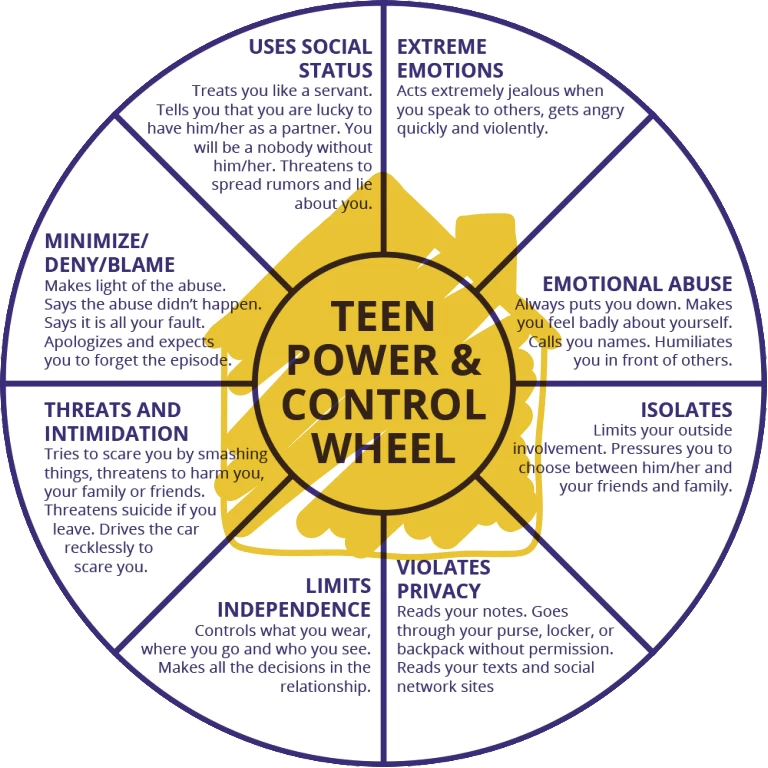
To start, take a look at this teen Power and Control Wheel. Power and Control Wheels are great tools to understand how the different forms of abuse can look in a realistic scenario, not just what they are. You may notice that certain types of abuse look different among teens than adults.
For parents, Safer Derbyshire lists several warning signs that a teen in your life may be experiencing abuse. Some signs of abuse may be:
- Unexplained physical marks, especially in hard-to-see places such as beneath clothing or above the hairline
- Lateness, truancy, or failing grades
- Withdrawal
- Changes in mood
- Isolation from others
- Excessive technology use
- Age-inappropriate knowledge of sexual topics
While these behaviors can certainly be frustrating for an outside observer, it is important to get curious about the why behind these behaviors. Remember, behavior is communication.
For teens, there are many red flags to look out for in unhealthy or abusive relationships. Your partner should not:
- Make you feel bad about who you are or what you care about
- Harm you or threaten to harm you
- Force or pressure you into any kind of sexual activity
- Prevent you from spending time with your family or friends
- Spread rumors about you or badmouth you online
- Force you to give them your money or other financial resources
- Make you feel unsafe
If you notice these signs in your relationship, consider notifying a trusted adult, like a parent, a teacher, a social worker, a coach, or any other adult that makes you feel safe.
Lastly, here are some online resources with more information about Teen Dating Violence and Healthy relationships.
SafeBae has helpful resources for parents and educators about how to talk to teens about healthy relationships. Also, if you are a teen and would like to learn how to talk to your peers about healthy relationships, SafeBae is a great place for you, too!
Love Is Respect also has a large amount of information about the signs of both healthy and unhealthy relationships.
As always, Safe Passage’s hotline is available 24/7 for anyone of any age experiencing abuse. Our counseling services are available to all survivors ages 4 and up. If you or someone you know needs help, please do not hesitate to reach out. No one deserves to be abused.
Written by: Harvey Green