


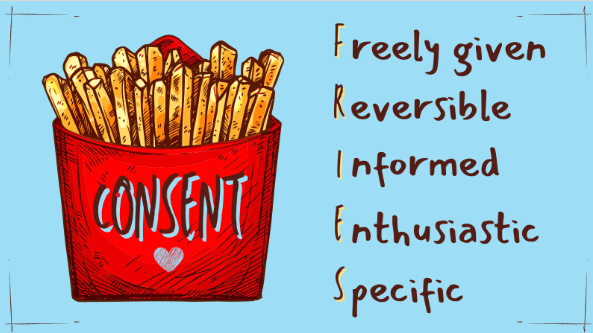
Consent is something that we use every day, and it’s important to make sure that we are giving and receiving good, positive consent. It’s an agreement, one in which everyone involved wants and accepts what’s happening. We can use the acronym FRIES as a gauge to know whether we have consent or not.
F is for freely given. This is a “yes” without pressure, under your own free will. To give an example, if I ask my friend to borrow their sweater and they say no, and I say, “Well I won’t be your friend anymore if you won’t let me borrow it,” that’s not consent. It’s not a yes if someone is pressured or threatened into changing their mind.
R is for reversible. This means you can take back consent at any time. You are allowed to change your mind even in the middle of an activity and there is never a point of “no return.” In a study of college students, over half of them felt that they had to go all the way if they started a sexual activity. Just know that if you ever change your mind and want to stop what you’re doing, it’s okay to. If you’re feeling uncomfortable, unsafe, or just don’t want to do it, you are allowed to say no.
I is for informed. Informed consent is when the person clearly knows what’s being asked and knows exactly what they are saying yes or no to. If someone is under the influence of drugs or alcohol then they cannot give consent. For example, if someone was drunk you wouldn’t give them the keys to your car. Just like the keys, those who have been drinking do not have the ability to make informed decisions and therefore cannot consent to sexual activity. Someone who is asleep or unconscious is also unable to give consent.
E is for enthusiastic. This means the person your asking should be genuinely interested in what’s happening. If the person seems unsure, hesitant, or uncomfortable, that’s a sign that they might not really be saying yes. It should be a happy yes! It doesn’t necessarily have to be a “jumping up and down” enthusiasm, but you can tell the difference when someone is really saying yes, and saying yes just because they feel like they have to. In this context it’s especially important to look at non-verbal communication and body language.
S is for specific. Saying yes to one thing doesn’t automatically mean saying yes to everything. For example, agreeing to a kiss doesn’t mean someone agreed to further activities. Consent is specific to a person(s) and activity. If another person(s) or activity is going to be introduced, then consent needs to be asked for again. Having clear boundaries and a specific agreement about what’s okay is essential for good consent.
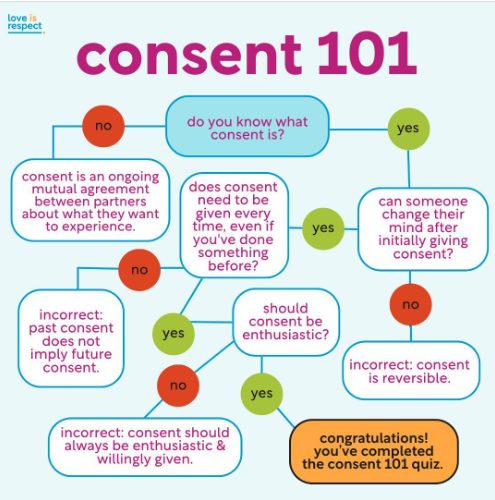
If you haven’t seen this video on consent, we recommend it!
Written by: Chelsea Nally